


Texas Hold’em is one of the most popular poker games in the world. Each player gets two private cards, shares five community cards with the rest of the table, and tries to make the best five-card hand. The game takes both skill and luck, so it can feel complicated the first time you sit down. This guide walks you through how to play step by step, explains the betting terms, and ranks all 10 poker hands from best to worst.
What is Texas Hold’em?
Texas Hold’em is played with a standard 52-card deck by up to 10 players. Each player gets two cards face down, and five community cards are dealt face up in the middle of the table in three stages (three on the flop, one on the turn, one on the river), shared by all players. Based on their cards, players decide whether to check, bet, call, raise or fold, and the player with the best five-card hand wins.

Where did Texas Hold’em come from?
Texas Hold’em began in the early 1900s in Robstown, Texas, as a game where each player held face-down cards and shared face-up cards with the table. It grew in popularity and had its first world tournament in 1970. Today it is one of the most widely played forms of poker, in casual games and in professional tournaments alike.
How to play Texas Hold’em step by step
Here is how a hand of Texas Hold’em plays out, from the first bet to the winner:
- Post the blinds: Before any cards are dealt, the two players to the left of the dealer post the small blind and the big blind.
- Deal the cards: The dealer deals two cards face down to each player. These private cards, known as “hole cards”, are only visible to the player who holds them.
- Play the first betting round: Betting moves clockwise around the table, starting with the player to the left of the big blind. Each player can call, raise or fold.
- Deal the community cards: After the first betting round, the dealer deals three community cards face up. This is the “flop”, followed by a betting round. The dealer then deals a fourth card (the “turn”) and a fifth card (the “river”), with a betting round after each.
- Decide the winner: If more than one player is left after the final betting round, each player shows their hole cards and makes the best five-card hand from any combination of their two hole cards and the five community cards. The best hand wins the pot. If everyone else folds earlier, the last player left wins the pot without showing.
Texas Hold’em betting terms
In each betting round, players can check, bet, call, raise or fold. This is what each term means, along with the names of the community cards:
| Term | Meaning |
|---|---|
| Fold | Give up your hand and leave the current round |
| Check | Pass without betting, allowed only when no one has bet in the round |
| Bet | Put the first chips into the pot in a betting round |
| Call | Match the current bet |
| Raise | Increase the current bet |
| Flop | The first three community cards |
| Turn | The fourth community card |
| River | The fifth and final community card |
| Blinds | Forced bets posted before the cards are dealt, which start the betting |

Texas Hold’em hand rankings: which hands win?
Every Texas Hold’em hand falls into one of 10 categories. From strongest to weakest, they are royal flush, straight flush, four of a kind, full house, flush, straight, three of a kind, two pair, one pair and high card.
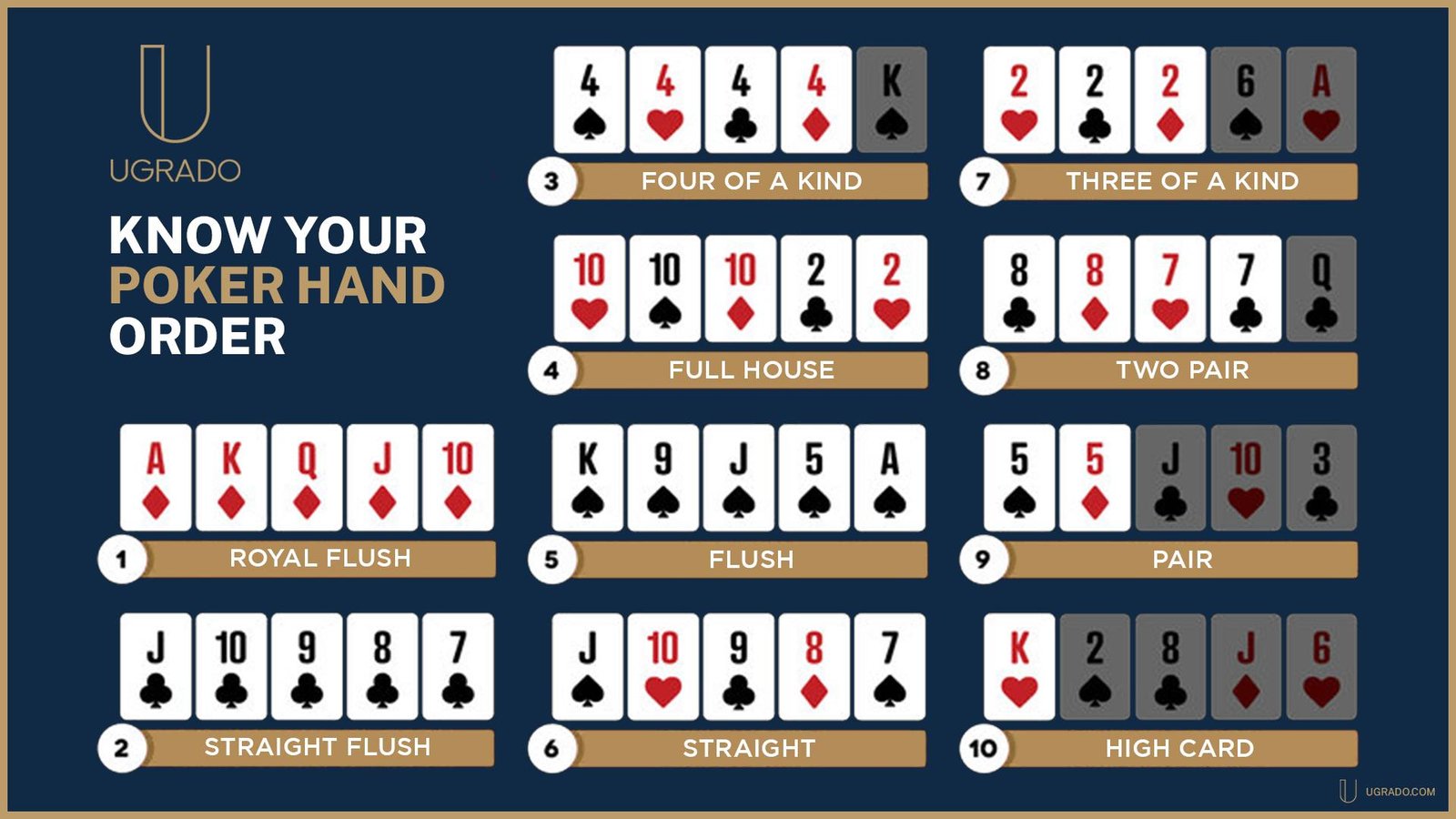
- Royal flush: A-K-Q-J-10, all in the same suit. The highest hand in poker.
- Straight flush: Five cards in a row, all in the same suit, for example 10-9-8-7-6 of diamonds. It is the second-highest hand, beaten only by a royal flush. If two players have a straight flush, the one with the higher top card wins.
- Four of a kind: Four cards of the same rank, for example 5-5-5-5. It beats every hand except a straight flush or royal flush. If two players have four of a kind, the higher four wins, so A-A-A-A is the best.
- Full house: Three cards of one rank plus a pair of another, for example 10-10-10-3-3. Between two full houses, the higher three of a kind wins. If both players have the same three of a kind, the higher pair wins.
- Flush: Any five cards of the same suit that are not in sequence, for example A-7-5-4-3 of spades.
- Straight: Five cards in a row that are not all the same suit, for example A-K-Q-J-10 in mixed suits.
- Three of a kind: Three cards of the same rank, for example 3-3-3.
- Two pair: Two different pairs in the same hand.
- One pair: Two cards of the same rank.
- High card: The weakest hand, five cards that make none of the hands above. It is ranked by its highest card, then the next highest, and so on.
Beyond the cards: reading your opponents
Knowing the hand rankings is the first thing to learn in Texas Hold’em, but it is only part of the game. Watch how your opponents behave and how they bet, and use that to decide when to push and when to fold. What you hold matters less than how well you play the people at the table.

 Top Bonus Pick