


Blackjack is a card game where you try to beat the dealer without going over 21. You receive two cards, add their values and choose whether to take another card or keep your total.
You do not need exactly 21 to win. A hand of 19 beats the dealer’s 18, while going over 21 means you bust and lose. Each player competes against the dealer, not against other players.
Blackjack Rules at a Glance
- Goal: Beat the dealer’s hand without exceeding 21.
- Card values: Number cards count as shown, picture cards count as 10, and Aces count as 1 or 11.
- Main choices: Hit or stand. Double, split and surrender may also be available.
- Blackjack: An Ace and a 10-value card in your initial, unsplit two-card hand.
- Table rules: Check the blackjack payout and whether the dealer hits or stands on soft 17.
These are standard blackjack basics. Individual games can have different rules.
What Are the Card Values in Blackjack?
Blackjack uses standard 52-card decks without jokers. Tables may use one deck or several shuffled together.
| Card | Value |
| 2–10 | The number shown |
| Jack, Queen or King | 10 |
| Ace | 1 or 11 |
Suits do not affect your main hand’s total.
How Does an Ace Work?
An Ace counts as 11 unless that would take the hand over 21, in which case it counts as 1.
For example:
- Ace + 6 = soft 17: The Ace counts as 11.
- Ace + 6 + 9 = 16: The Ace now counts as 1.
A soft hand contains an Ace counted as 11. A hard hand has no Ace counted as 11, such as 10 + 7 or Ace + 6 + 10.
How to Play Blackjack Step by Step
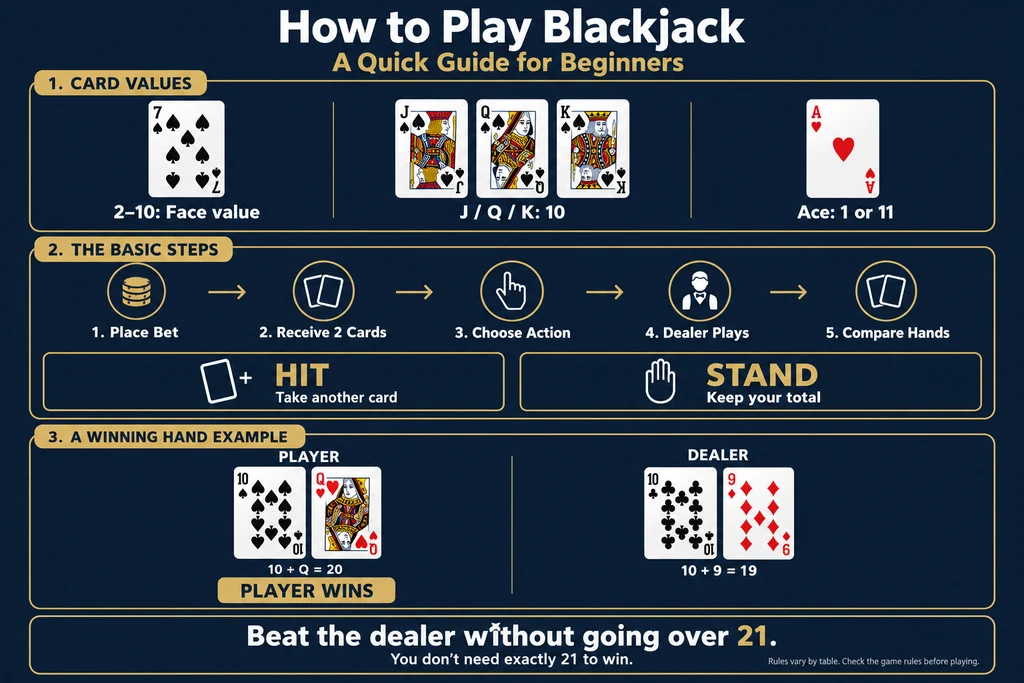
1. Place Your Bet
Place your main bet before the cards are dealt, within the table’s minimum and maximum limits. Side bets are optional and separate from the main game.
2. Receive Two Cards
You receive two cards. The dealer shows one face-up card, called the upcard.
In many games, the dealer also has a face-down card. In others, the dealer receives their second card after the players act.
3. Choose Your Action
Add your card values and decide how to play your hand.
| Action | What It Means |
| Hit | Take another card. |
| Stand | Keep your total and end your turn. |
| Double down | Usually double your original bet, receive one final card and end your turn. |
| Split | Separate an eligible pair into two hands, adding a second bet equal to the first. |
| Surrender | Where offered, end an eligible starting hand and recover half your bet. |
Double, split and surrender rules vary by game. You cannot use every option on every hand.
If your total goes over 21, you lose immediately. The dealer busting later does not return your bet.
4. The Dealer Plays
The dealer follows fixed rules rather than choosing freely:
- Hit on 16 or less.
- Stand on hard 17 or more.
- Hit or stand on soft 17, depending on the table.
Soft 17 is a hand such as Ace + 6. Check the table rules to see how the dealer must play it.
5. The Result Is Settled
For ordinary hands that have not busted:
- Your total is higher: You win.
- The dealer’s total is higher: You lose.
- The totals match: It is a push, and your bet is returned.
- The dealer busts: Your remaining hand wins.
Is Blackjack the Same as Getting 21?
No. Blackjack is an Ace plus a 10-value card in your initial, unsplit two-card hand. A three-card hand such as 7 + 5 + 9 also totals 21, but it is an ordinary 21.
A blackjack beats an ordinary 21. If both you and the dealer have blackjack, the main bet normally pushes.
After splitting Aces, receiving a 10-value card normally creates an ordinary 21 rather than a blackjack. Split-Ace restrictions should be checked in the game rules.
How Do Blackjack Payouts Work?
Ordinary winning hands normally pay 1:1. Blackjack commonly pays 3:2, although some tables pay 6:5.
Here is what those payouts mean for a 10-unit bet:
| Result | Profit or Loss | Total Returned |
| Ordinary win at 1:1 | +10 units | 20 units |
| Blackjack at 3:2 | +15 units | 25 units |
| Blackjack at 6:5 | +12 units | 22 units |
| Push | 0 | 10 units |
| Loss | −10 units | 0 |
Examples exclude doubles, splits, surrender and side bets. Blackjack wins assume the dealer does not also have blackjack.
A 3:2 payout returns more than 6:5 for the same blackjack and stake. Learn more about game types and key rules in Ugrado’s online blackjack guide.
A Simple Blackjack Round Example
You place a 10-unit bet:
- Your cards are 8 + 5 = 13. The dealer shows a 10.
- You hit and receive a 7, bringing your total to 20.
- You stand.
- The dealer reveals a 6, making 16, then draws a 3 to reach 19.
- Your 20 beats 19. You win 10 units and receive 20 units in total, including your original stake.
This shows why reaching exactly 21 is not necessary to win.
What Should Beginners Check Before Playing?
As with other online casino games, check the specific blackjack rules before placing your bet:
- Blackjack payout: Does the table pay 3:2 or 6:5?
- Soft 17: Does the dealer hit or stand?
- Double and split rules: Which hands qualify, and what restrictions apply?
- Surrender: Is it available?
- Special rules: Does the variant change ordinary wins, ties or payouts?
You may also see insurance when the dealer shows an Ace. It is a separate wager that the dealer has blackjack, not protection against every losing outcome. You do not need to accept it to continue your main hand.
Once you understand the rules, a basic strategy chart can help with decisions. Use one that matches the table’s rules, since the correct action can depend on your hand, the dealer’s upcard and the game configuration.
To learn the mechanics without wagering money, practise with a deck of cards and pretend chips or use a free practice mode where available.
Frequently Asked Questions (FAQ)
How many cards do you start with in blackjack?
You start with two cards. You can then take additional cards by choosing hit, subject to the game’s rules and your hand remaining in play.
What is an Ace worth in blackjack?
An Ace counts as 1 or 11. It counts as 1 when using 11 would take your hand over 21. For example, Ace + 6 is soft 17, while Ace + 6 + 9 totals 16.
What is the difference between hit and stand?
Hit means take another card. Stand means keep your current total and end your turn. The appropriate choice depends on your hand, the dealer’s upcard and the table rules.
Is getting 21 always a blackjack?
No. A blackjack is an Ace and a 10-value card in your initial, unsplit two-card hand. Reaching 21 with three or more cards is an ordinary 21 and normally pays at the standard winning rate.
What happens if both the player and dealer bust?
If you bust first, your main bet loses immediately. The dealer busting later does not return your bet or make the result a tie.
Does the dealer win a tie in blackjack?
Equal ordinary totals normally produce a push, and your main bet is returned. However, a dealer blackjack beats an ordinary 21 made with three or more cards.

 Top Bonus Pick