

Penny slots may sound inexpensive, but a 1-cent denomination does not necessarily mean each spin costs just one cent. Modern penny slot machines often require players to wager across multiple paylines, increasing the total cost of each spin.
For example, a penny slot with 40 active paylines and a minimum wager of one credit per line costs $0.40 per spin, not $0.01. Increasing the bet level can raise that amount to several dollars.
Understanding these costs is essential before playing.
In this guide, we’ll explain what penny slots are, how to play penny slots, and how to calculate the actual cost per spin. We’ll also examine official Nevada gaming statistics to compare penny slots with higher-denomination machines and explore how minimum bets work in online slots.
What Are Penny Slots?
A penny slot is a machine with a base denomination of one cent. Every credit on screen is one penny. Penny slots are slot machines with a base denomination of one cent ($0.01) per credit. However, the denomination represents the value of an individual credit, not the total cost of a spin.
For example, on a penny slot machine:
- 1 credit = $0.01
- 10 credits = $0.10
- 50 credits = $0.50
- 100 credits = $1.00
Modern video slots frequently allow wagers across multiple paylines, with players selecting how many credits to stake per line.
As a result, the total wager depends on several factors, including the credit denomination, the number of active paylines, and the number of credits wagered per line.
How Is the Cost per Spin Calculated?
For conventional payline-based penny slots, the total wager can be calculated using this formula:
Total Bet per Spin = Active Paylines × Credits per Line × Credit Value
For example, consider a penny slot with 40 active paylines.
| Credits per line | Active paylines | Total bet per spin |
|---|---|---|
| 1 credit | 40 | $0.40 |
| 2 credits | 40 | $0.80 |
| 5 credits | 40 | $2.00 |
| 10 credits | 40 | $4.00 |
As shown above, increasing the number of credits wagered per line directly increases the total cost of each spin.
Some slot machines also feature fixed paylines that you can’t reduce. For instance, a 50-payline penny slot requiring at least one credit per line has a minimum wager of $0.50 per spin.
However, not all slot games use this calculation. Games featuring ways-to-win systems or alternative wagering structures may calculate their total bets differently.
To understand the differences between paylines, credits, and other slot mechanics, refer to our guide on slot machine spin terms.
How to Play Penny Slots: Understanding the Bet Panel
Learning how to play penny slots begins with understanding the information displayed on the game’s betting panel.
Before starting a spin, review the available wagering options to determine how much money will be deducted from your balance.
1. Total Bet
The Total Bet field displays the amount wagered on each spin.
Depending on the machine, this value may appear in credits or currency.
For example, a total wager of 250 credits on a machine with a $0.01 denomination equals $2.50 per spin.
2. Lines or Ways
This field indicates the number of active paylines or winning ways available in the game.
Some slot machines allow players to adjust the number of active paylines, while others use a fixed-line system.
If the paylines are fixed, the minimum wager must cover all active lines according to the game’s betting rules.
3. Bet Level or Coins per Line
The Bet Level determines how many credits are wagered on each active payline.
Increasing this setting raises the total amount staked per spin.
Check whether the game automatically updates the Total Bet when the bet level changes.
4. Credits and Cash Display
Some slot machines allow players to switch between displaying their balance in credits and showing the equivalent currency amount.
For example, a balance of 5,000 credits on a penny slot represents $50.00.
Viewing the balance in currency can make it easier to understand actual spending.
5. Additional Feature Bets
Certain slot games offer optional features that require higher wagers.
These may include enhanced bonus eligibility or additional gameplay options, depending on the game.
Before enabling any optional feature, check whether it increases the total cost per spin.
For a broader introduction to slot mechanics, explore our beginner’s guide to online slots.
Why Do Penny Slots Have a Higher Casino Hold? Nevada Gaming Statistics
Although penny slots allow relatively small individual wagers, they may have a higher casino hold percentage than some higher-denomination machines.
Casino hold, also called the casino win percentage for slot machines, represents the proportion of total money wagered that the casino retains over a reporting period.
For example, if players collectively wager $1 million and a casino retains $80,000, the casino hold percentage is 8%.
The remaining $920,000 represents the amount returned to players in aggregate during that period.
Nevada Slot Machine Hold Percentages (August 2025–July 2026)
According to the Nevada Gaming Control Board’s July 2026 Monthly Revenue Report, the statewide slot machine statistics for nonrestricted gaming locations were as follows:
| Slot Denomination | Average Number of Machines | Casino Hold Percentage |
|---|---|---|
| 1 Cent | 28,154 | 8.78% |
| 5 Cent | 540 | 6.18% |
| 25 Cent | 2,131 | 7.50% |
| 1 Dollar | 4,697 | 6.22% |
| 5 Dollars | 403 | 4.37% |
| 25 Dollars | 67 | 7.48% |
| 100 Dollars | 53 | 4.88% |
| Multi-Denomination | 88,790 | 6.96% |
| All Slot Machines | 125,721 | 7.10% |
Source: Nevada Gaming Control Board, Monthly Revenue Report, July 2026. Figures cover the 12-month period from August 1, 2025, to July 31, 2026.
During this reporting period, penny slot machines recorded an average casino hold of 8.78%, compared with 6.22% for $1 slot machines.
For July 2026 alone, the reported casino hold percentages were:
- 1-cent slots: 8.45%
- $1 slots: 5.76%
- All slot machines: 7.17%
These figures suggest that penny slots retained a greater proportion of wagers than dollar-denomination machines during the specified reporting periods.
However, these statistics represent aggregated casino performance, not the guaranteed return of an individual machine.
Why Might Penny Slots Have Higher Hold Percentages?
Several factors may contribute to the difference between slot denominations.
Casinos may offer different payout configurations across slot denominations. Lower-denomination games can be configured with different theoretical return percentages from higher-denomination machines.
Modern penny slots frequently include licensed themes, interactive bonus rounds, and progressive jackpot features.
These features may influence game design and commercial decisions, although the Nevada report does not establish them as direct causes of higher hold percentages.
The statistics represent different groups of machines, casinos, and wagering patterns.
Therefore, the results should not be interpreted as a controlled comparison of otherwise identical games.
The Nevada Gaming Control Board publishes the observed figures but does not identify a single definitive reason why penny slots recorded a higher hold percentage.
Important: A lower casino hold percentage does not guarantee better results in an individual session. Actual outcomes remain random, and players can lose more or less than the statistical average.
Penny Slots Online: Understanding Minimum Bet Slots
Unlike traditional land-based penny slot machines, penny slots online typically display a total wager per spin rather than emphasizing the denomination of an individual credit.
Many online slot games use fixed paylines, ways-to-win systems or alternative payout structures.
This means the minimum bet can vary significantly between games, even when they offer similar features.
For players comparing minimum-bet slots, the most important information is the lowest total wager each game accepts.
The following examples illustrate how minimum betting requirements differ between online slots.
1. Starburst (NetEnt)

Starburst is a five-reel online slot developed by NetEnt, featuring colourful gemstone symbols and expanding Wilds.
The game offers a relatively low minimum wager, making it a useful example when comparing online slot betting ranges.
Key Features
- Provider: NetEnt
- Layout: 5 reels and 3 rows
- Paylines: 10, paying in both directions
- Minimum bet: €0.10 per spin
- Maximum bet: €100.00 per spin
- Published RTP: 96.08%
- Maximum payout: 800× the total bet
According to NetEnt’s official Starburst game specifications, the minimum wager is €0.10 per spin.
All ten paylines remain active, and players can increase their total wagers by adjusting the available bet settings.
However, betting limits may vary depending on the casino, game configuration and currency.
2. Wanted Dead or a Wild (Hacksaw Gaming)
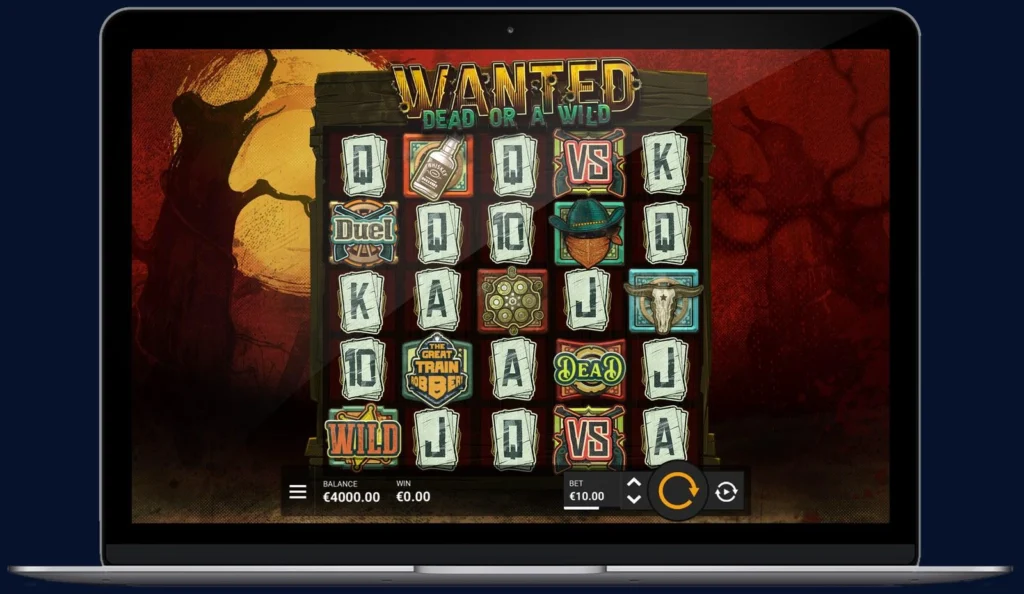
Wanted Dead or a Wild is a Western-themed online slot developed by Hacksaw Gaming.
The game features multiple bonus rounds, including DuelReels and The Great Train Robbery.
Key Features
- Provider: Hacksaw Gaming
- Layout: 5 reels and 5 rows
- Paylines: 15
- Minimum bet: Commonly reported at €0.20 or £0.20
- Maximum bet: Commonly reported at €100 or £100, depending on the version and operator
- Published RTP options: 96.38%, 94.55%, 92.33% and 88.42%
- Maximum payout: 12,500× the total bet
Independent Wanted Dead or a Wild slot reviews commonly report a minimum wager of 0.20 in the relevant currency.
However, the exact betting range depends on the operator and game configuration.
More importantly, Hacksaw Gaming’s official game specifications identify four different RTP versions.
This illustrates why players should not assume that every casino offers the same theoretical return for an identical slot title.
For example, the 88.42% RTP version has a theoretical house advantage of 11.58%.
That figure should not be directly treated as the observed hold of Nevada penny slots because the calculations come from different environments and measurement methods.
Players should check the RTP displayed in the game’s information panel whenever it’s available.
3. Sweet Bonanza (Pragmatic Play)
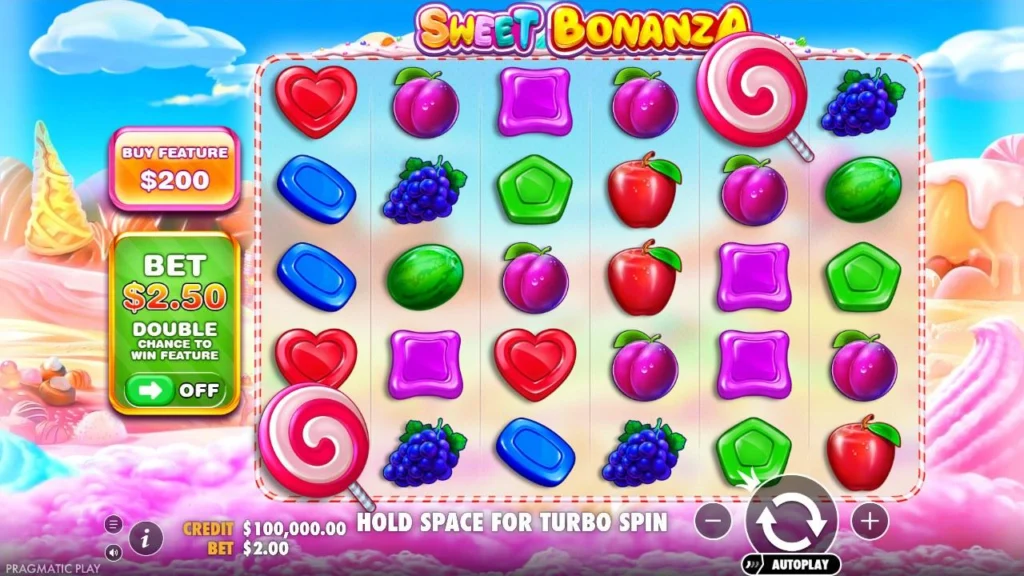
Sweet Bonanza is an online slot developed by Pragmatic Play. It features a candy-themed design, a cluster-based payout system, and tumbling reels.
Unlike traditional payline slots, Sweet Bonanza awards wins through matching symbols appearing anywhere on the game grid, according to its rules.
The game also includes free spins and multiplier features.
Key Features
- Provider: Pragmatic Play
- Layout: 6 reels and 5 rows
- Payout system: Pay-anywhere mechanics
- Published default RTP: 96.48%
- Main features: Tumbling symbols, free spins, and multipliers
- Minimum bet: Varies according to the casino and available game configuration
Pragmatic Play’s official Sweet Bonanza game page provides information about the game’s features and payout mechanics.
Although Sweet Bonanza has a commonly published default RTP of 96.48%, operators may offer other RTP configurations.
For further comparisons, read Ugrado’s guide to Pragmatic Play slots with high RTP.
Are Online Penny Slots Really Cheaper?
Some online slots offer minimum wagers of approximately €0.10 or €0.20 per spin, while land-based penny slot machines may require wagers of $0.40, $0.50, or more.
However, not every online slot has a minimum bet of 10 or 20 cents.
Actual betting limits depend on the game, casino, currency, and applicable configuration.
Also, don’t confuse the minimum wager with the game’s theoretical payout percentage.
A game with a lower minimum bet is not necessarily more favorable in terms of RTP or volatility.
Players should compare the total bet per spin, published RTP, and game rules before drawing conclusions about potential playing costs.
How Much Does an Hour on a Penny Slot Cost?
The total cost of playing penny slots depends on the amount wagered per spin, the number of spins played, and the game’s actual results.
Although slot outcomes are random, historical casino hold percentages can help illustrate theoretical long-term wagering costs.
For example, consider the following assumptions:
- Playing time: 1 hour
- Number of spins: 500
- Casino hold percentage: 8.78%
- Reference: Nevada’s reported 1-cent slot machine hold for August 2025–July 2026
The theoretical expected loss can be estimated using this formula:
Expected Loss = Total Amount Wagered × Casino Hold Percentage
Estimated Cost Based on Different Bet Sizes
| Bet per spin | Total Wagered (500 spins) | Theoretical Expected Loss |
|---|---|---|
| $0.40 | $200.00 | $17.56 |
| $1.00 | $500.00 | $43.90 |
| $2.50 | $1,250.00 | $109.75 |
For example, placing 500 wagers of $1.00 results in a total wagering volume of $500.
Applying the historical 8.78% casino hold produces an estimated theoretical loss of $43.90.
However, this does not mean a player will lose exactly $43.90 during a one-hour session.
Actual results can differ considerably because slot outcomes are random and short-term performance is affected by volatility.
The calculation is an illustrative long-term statistical estimate based on aggregated Nevada data, not a prediction of any individual session or machine.
Comparing Penny Slots With Dollar Slots
Nevada’s July 2026 report provides another useful comparison.
For the 12-month period ending July 31, 2026:
- Penny slot casino hold: 8.78%
- Dollar slot casino hold: 6.22%
If $500 is wagered, the theoretical expected losses based on these historical figures are:
| Slot Denomination | Total Wagered | Casino Hold | Theoretical Expected Loss |
|---|---|---|---|
| 1 Cent | $500 | 8.78% | $43.90 |
| 1 Dollar | $500 | 6.22% | $31.10 |
The difference is approximately $12.80 per $500 wagered.
However, these results reflect statewide averages across different groups of machines. They do not guarantee that a particular dollar slot will offer a higher RTP than a particular penny slot.
The most reliable way to compare individual games is to examine their published RTP information, where available, and their specific wagering rules.
Penny Slots vs Dollar Slots: Which Should You Choose?
When comparing penny slots with higher-denomination machines, consider several factors.
1. Minimum Bet Requirements
Penny slots may suit players who want lower minimum wagers.
However, a one-cent denomination does not automatically translate into a one-cent minimum bet.
Always check the total wager required for each spin.
2. Casino Hold and RTP
Nevada’s historical gaming statistics show that penny slots had a higher average casino hold than dollar-denomination machines during the 12 months ending July 2026.
Nevertheless, individual machines may have different payout configurations.
When comparing online slots, review the actual RTP version the casino offers rather than relying only on the game’s name or minimum wager.
For more information, explore Ugrado’s guide to RTP and volatility in slot games.
3. Gameplay Features
Penny slot machines often feature video-based gameplay, themed graphics and interactive bonus rounds.
Higher-denomination machines may offer different game formats or feature structures.
Available features depend on the specific title, not the denomination alone.
4. Playing Budget
A lower minimum bet can make it easier to choose a smaller wager, but frequent spins can still generate substantial wagering volume.
For example, 500 spins at $0.40 involve $200 in total wagers.
This is the cumulative amount wagered, not necessarily the amount lost or the initial balance required.
Players should establish a spending limit before playing and avoid increasing wagers to recover previous losses.
For additional guidance, visit Ugrado’s responsible gaming page.
Conclusion: Are Penny Slots Really Worth a Penny?
Penny slots refer to machines with a one-cent credit denomination, not necessarily games that cost one cent per spin.
The actual cost depends on the number of active paylines, credits wagered per line and any additional betting features.
For example, a 40-payline penny slot with one credit wagered per line costs $0.40 per spin. Increasing the bet level can raise that amount considerably.
According to Nevada Gaming Control Board data for August 2025 through July 2026, penny slot machines recorded an average casino hold of 8.78%, compared with 6.22% for dollar-denomination machines.
However, these statistics represent historical statewide averages and should not be interpreted as guaranteed results for individual games.
For online penny slots, minimum wagers and RTP settings vary by provider and operator.
Before playing, check the total bet per spin, review the game’s RTP, and understand its wagering conditions. Choosing a lower stake may reduce the amount risked per spin, but it does not improve your odds or eliminate the risk of losing money.
Frequently Asked Questions (FAQs)
What are penny slots?
Penny slots are slot machines with a base credit denomination of one cent ($0.01). Although each credit is worth one cent, the total wager per spin may be higher because players often bet across multiple paylines.
How much does a spin on a penny slot really cost?
The cost depends on the number of active paylines, credits wagered per line and the credit denomination.
For example, a 40-payline penny slot with one credit wagered per line costs $0.40 per spin. Increasing the wager to five credits per line raises the total cost to $2.00.
Do penny slots have worse odds than dollar slots?
Nevada Gaming Control Board data for the 12 months ending July 31, 2026, shows that penny slots had a higher average casino hold percentage than dollar-denomination machines: 8.78% compared with 6.22%.
However, this comparison reflects statewide historical averages. It does not mean every penny slot has a lower theoretical RTP than every dollar slot.
What is the minimum bet on penny slots online?
Minimum bets vary by game and operator.
For example, NetEnt’s Starburst has an official minimum bet of €0.10 per spin, while Wanted Dead or a Wild is commonly listed with a minimum wager of approximately €0.20 or £0.20.
Players should confirm the minimum stake in the specific game’s betting panel.
Can I play penny slots for one cent per spin?
Some slot machines allow wagers as low as one cent when a single credit can be placed on one active payline. However, many modern penny slots use fixed paylines, meaning the minimum cost per spin is higher.
For example, a game with 50 fixed paylines requiring one credit per line has a minimum wager of $0.50 per spin.
Are penny slots better for beginners?
Penny slots can offer relatively low minimum wagers, but they are not necessarily easier to win or more favorable than other slot denominations.
Beginners should understand how credits, paylines and total wagers work before playing.
What is the difference between penny slots and minimum bet slots?
Penny slots traditionally refer to machines with a one-cent credit denomination.
Minimum bet slots are games that allow relatively small total wagers per spin, regardless of their underlying credit denomination or payout system.
Online slots are typically compared by minimum total wager rather than credit denomination.
Does betting more increase your chances of winning on penny slots?
Increasing the wager generally increases the amount at risk and may increase the value of eligible payouts.
However, a larger bet does not automatically improve the probability of winning.
Some games have specific bet-dependent features or eligibility requirements, so players should consult the official paytable and game rules.

 Top Bonus Pick