

When choosing an online slot, you may come across terms such as RTP, low volatility and high volatility. These numbers and ratings can help you understand how a slot is designed, but they are often misunderstood.
In simple terms, RTP shows a slot’s theoretical return over the long term, while volatility describes how its payouts tend to vary in size and frequency.
A slot can have a high RTP and still be highly volatile. Two slots can also have the same RTP but offer very different playing experiences.
Here is what each term actually means and how to use them when comparing online slots.
What Is RTP in Online Slots?
RTP stands for Return to Player. It is a percentage that represents how much of all money wagered on a slot is theoretically returned to players over a very large number of spins.
For example, imagine a slot has an RTP of 96%.
This means that, theoretically, the game is designed to return RM96 for every RM100 wagered across a very large volume of play.
However, it does not mean that if you personally wager RM100, you will get RM96 back.
Your result could be higher or lower because RTP is calculated over the long term rather than an individual session.
What Does 96% RTP Actually Mean?
If a slot has a 96% RTP:
- it does not guarantee a 96% return for each player;
- it does not mean 96 out of every 100 spins will win;
- it does not tell you when the next win will happen; and
- it does not mean a losing streak makes a win more likely on the next spin.
Think of RTP as information about the mathematical design of the game, rather than a prediction of your own results.
What Is Volatility in Slots?
Slot volatility describes how much the payouts of a slot tend to vary.
Unlike RTP, volatility is usually described as low, medium or high rather than as a percentage.
It gives you an idea of the general payout pattern you may encounter.
Low-Volatility Slots
Low-volatility slots are generally designed around smaller, more frequent payouts.
The potential individual wins may be less dramatic, but the payout pattern tends to involve less variation.
Medium-Volatility Slots
Medium-volatility slots sit between low and high volatility.
They generally combine elements of both, with a balance between payout frequency and potential payout size.
High-Volatility Slots
High-volatility slots generally have greater variation between payouts.
Wins may occur less frequently, while some potential payouts can be larger compared with a lower-volatility game.
This does not mean a high-volatility slot is better or worse. It simply describes a different mathematical payout pattern.
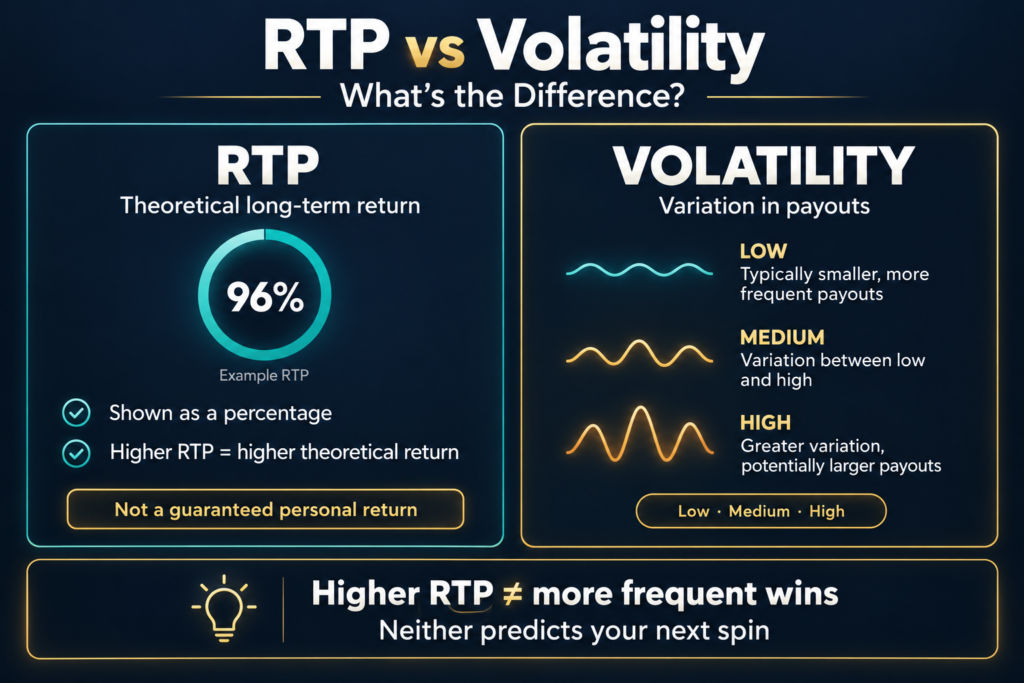
RTP vs Volatility: What’s the Difference?
Here’s the easiest way to separate the two:
RTP tells you about the theoretical return. Volatility tells you how that return may be distributed.
| RTP | Volatility | |
| What it describes | Theoretical long-term return | Payout pattern |
| Usually shown as | A percentage | Low, medium or high |
| Higher means | Higher theoretical return | Greater variation in payouts |
| Predicts your next spin? | No | No |
And this is where players sometimes get confused.
A slot with a higher RTP doesn’t necessarily pay more often. Likewise, a high-volatility slot doesn’t automatically have a lower RTP.
They are two separate parts of the game’s maths.
Can Two Slots Have the Same RTP but Different Volatility?
Yes.
Imagine two slots that both have an RTP of 96%.
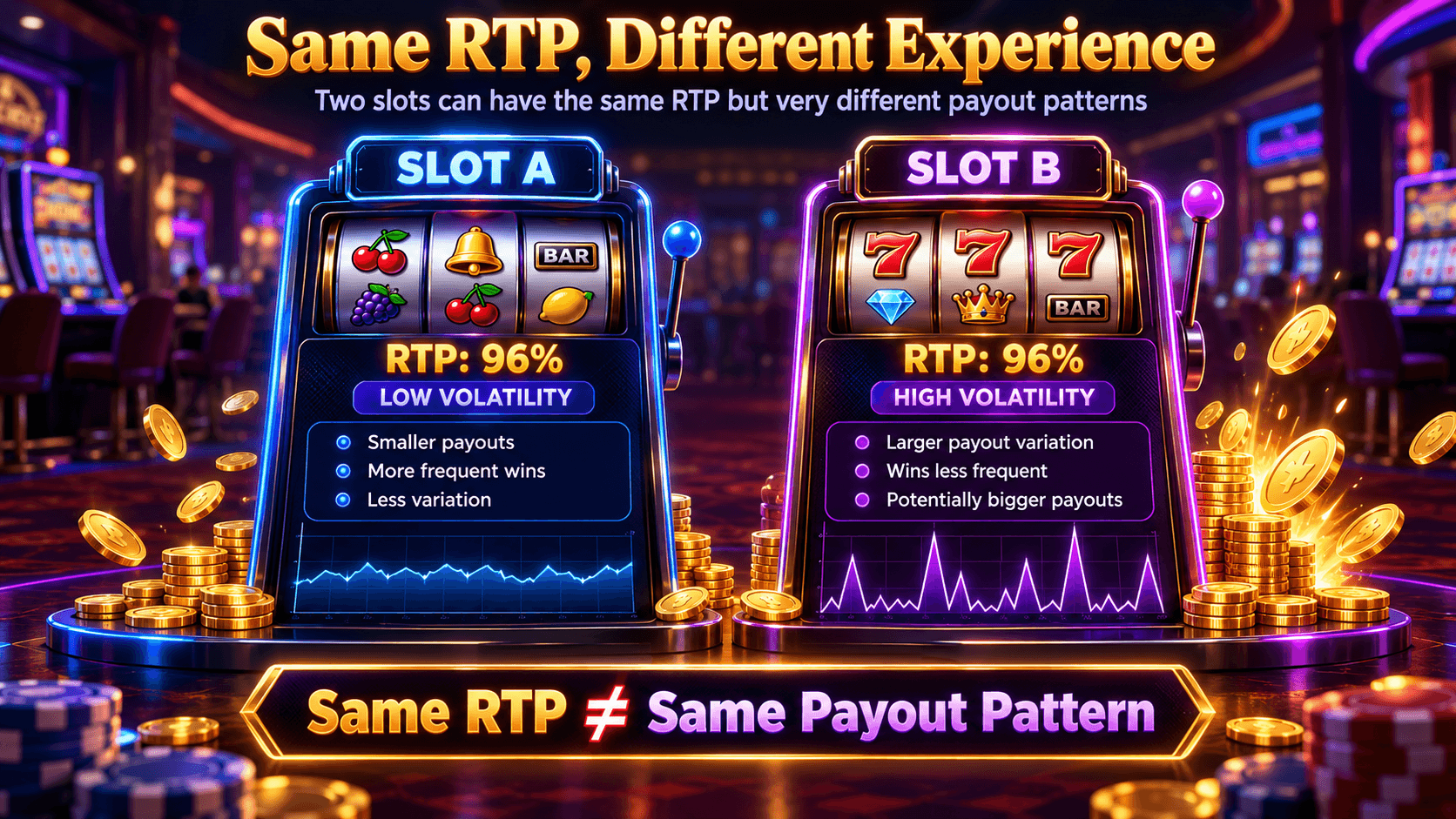
Slot A
RTP: 96%
Volatility: Low
General pattern: Smaller payouts occurring more frequently
Slot B
RTP: 96%
Volatility: High
General pattern: Greater variation, with potentially larger but less frequent payouts
Both games have exactly the same theoretical RTP, but their payout patterns can be very different.
This is why two slots with similar RTP percentages do not necessarily feel the same to play.
The same principle works in reverse. Two games can have similar volatility levels while having different RTP percentages.
Does a Higher RTP Mean You Will Win More Often?
No. A higher RTP does not automatically mean more frequent wins.
RTP tells you about theoretical returns over the long term. It does not measure how often winning combinations occur.
This distinction is important because a high-RTP slot can still have high volatility. A large part of its theoretical return may be distributed through less frequent payouts rather than many small wins.
Similarly, a lower-volatility slot may produce smaller payouts more frequently without necessarily having a higher RTP.
Does High Volatility Mean Low RTP?
No.
RTP and volatility are separate characteristics, so high volatility does not automatically mean low RTP.
A slot can be:
- high RTP + high volatility
- high RTP + low volatility
- lower RTP + high volatility
- lower RTP + low volatility.
This is another reason why looking at only one metric does not give you the full picture of how a slot is designed.
Can RTP and Volatility Predict When a Slot Will Pay?
No. RTP and volatility cannot predict the outcome of your next spin.
Online slots use a Random Number Generator (RNG) to determine game outcomes. RTP and volatility describe mathematical characteristics of the game rather than providing a schedule for when wins will occur.
For example, if a slot has gone through many spins without a large payout, that does not mean a large win must be coming soon.
Likewise, a slot that has just produced a large win does not automatically become less likely to produce another one.
This is why RTP and volatility are useful for understanding and comparing slots, but not for predicting individual outcomes.
How Do You Check a Slot’s RTP and Volatility?
You can usually find a slot’s RTP in its game information, help section or paytable.
Depending on the game and provider, volatility may also be displayed in the game information. It may appear as:
- Low, Medium or High;
- a numerical scale; or
- another form of volatility rating.
If the information is not displayed clearly in the game itself, you may also find it on the game provider’s official website.
One thing to watch for is that some slot games can be offered in different RTP configurations. This means the RTP you see on one website or review may not necessarily match the version available at another casino.
Always check the information for the specific version of the game you are viewing.
Should You Look at RTP or Volatility When Choosing a Slot?
It is more useful to consider RTP and volatility together because each tells you something different.
RTP helps you compare the theoretical long-term return of different games.
Volatility helps you understand the general payout pattern and how much those payouts may
vary.
For example, someone who prefers less variation may look towards lower-volatility games, while someone comparing games with greater payout variation may look at higher-volatility slots.
Neither metric tells you whether you will win.
Instead, use them as game information, alongside other factors such as the game’s mechanics, features and betting range, to understand what you are choosing before you play.
Frequently Asked Questions (FAQ)
No. RTP and volatility measure different things. RTP represents a slot’s theoretical long-term return, while volatility describes how much its payouts tend to vary in size and frequency.
A 96% RTP means a slot is theoretically designed to return 96% of all wagers over a very large number of spins. However, it does not guarantee that an individual player will receive 96% of their wagers back.
No. A higher RTP does not mean you are more likely to win an individual spin. It represents a higher theoretical return over the long term, but does not tell you how often winning spins will occur.
Yes. A slot can have both high RTP and high volatility. RTP measures theoretical long-term return, while volatility describes the payout pattern, so a high value in one does not determine the other.
It can be. Some slot developers make the same game available with multiple RTP configurations. Casinos may therefore offer different versions of the same title. Check the game information for the version you are actually playing.
Neither is automatically better. Low-volatility and high-volatility slots have different payout patterns. The more relevant question is which type of payout pattern you prefer.
 Top Bonus Pick