
No. AI can analyse online slot results, recognise symbols in screenshots and calculate how much a player has won or lost, but it cannot predict the outcome of the next spin.
ChatGPT, for example, can examine a list of previous payouts, spot patterns and explain game features such as bonus requirements and multipliers. Knowing what happened in the last ten spins still doesn’t tell it what will happen on spin 11. We tested how ChatGPT interpreted a JILI Super Ace demo screenshot and used a simulated spin history to illustrate what it can calculate.
What Can AI Learn From Your Spin History?
Consider a player who makes ten spins at RM1 each. The figures below are a simulated example, not a live casino session or a test of any predictor.
| Spin | Payout |
|---|---|
| 1 | RM0.00 |
| 2 | RM0.00 |
| 3 | RM0.50 |
| 4 | RM0.00 |
| 5 | RM0.00 |
| 6 | RM0.00 |
| 7 | RM3.00 |
| 8 | RM0.00 |
| 9 | RM0.00 |
| 10 | RM0.00 |
ChatGPT can calculate the results easily:
- Total stake: RM10.00
- Total payout: RM3.50
- Net loss: RM6.50
- Session return: 35%
It can also tell a spin that returns money from one that makes a profit. Spin 3 paid RM0.50 on a RM1 stake, so it was still a loss. Spin 7 returned RM3, making it the only profitable spin in this example.
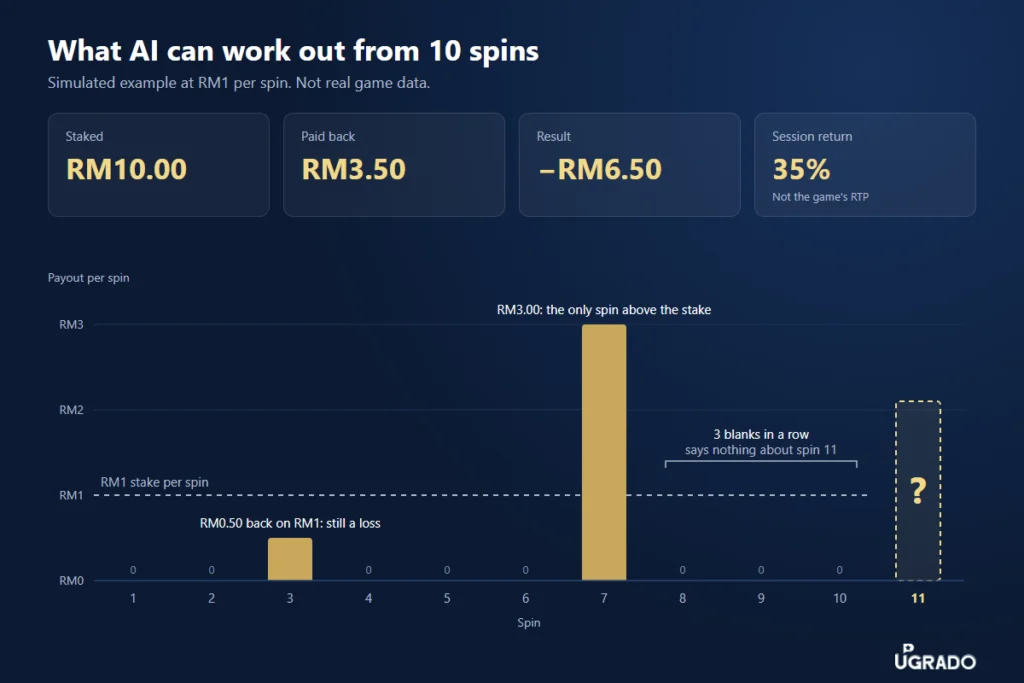
ChatGPT can also see that the final three spins returned nothing. Does that make spin 11 more likely to pay? No. Those three losing spins give no indication of what comes next. The same applies to the session’s 35% return: it describes those ten spins, not the game’s long-term payout.
This is where players sometimes confuse session results with Return to Player (RTP). A game’s published RTP is its theoretical return over a very large number of plays, not a percentage any player will receive in one session. Our guide to RTP and volatility in slots explains both.
Can ChatGPT Predict Slots With 100 or 1,000 Previous Spins?
No. Even with 1,000 previous spins, ChatGPT cannot predict the next spin of a properly functioning online slot from that history alone. With more records, it can estimate how often spins paid out, calculate the average payout and identify losing streaks.
Imagine ChatGPT notices that a payout often followed three spins with no payout. That pattern describes the records you gave it. It does not establish that a payout is more likely after the next such streak.
To show that the pattern has predictive value, the model would need to record its predictions before the spins take place and beat a simple benchmark on fresh results that it did not use to find the pattern.
Can AI Predict a Slot Spin From a Screenshot?
A screenshot gives AI more than a list of payouts: the game’s interface, symbols, bet amount and bonus progress. ChatGPT can use this to explain what is on screen. If a game needs five matching symbols to trigger a feature and the screenshot shows four, AI can tell you one more is needed. It cannot tell you whether that symbol will land on the next spin.
Our JILI Super Ace Screenshot Test
We tested ChatGPT with a screenshot from the JILI Super Ace demo to see whether it could read the game’s interface correctly. It identified the visible symbols, the 200 bet and the zero win, and said the screenshot showed no reliable visual pattern pointing to a payout.
It then misread the multiplier display. Super Ace has a combo multiplier with x1, x2, x3 and x5 levels that apply to successive winning cascades. They are not bet amounts. ChatGPT treated the bar as betting options and advised against increasing the bet to x2, x3 or x5. Even when AI identifies what is on screen correctly, it can misunderstand how a game feature works.
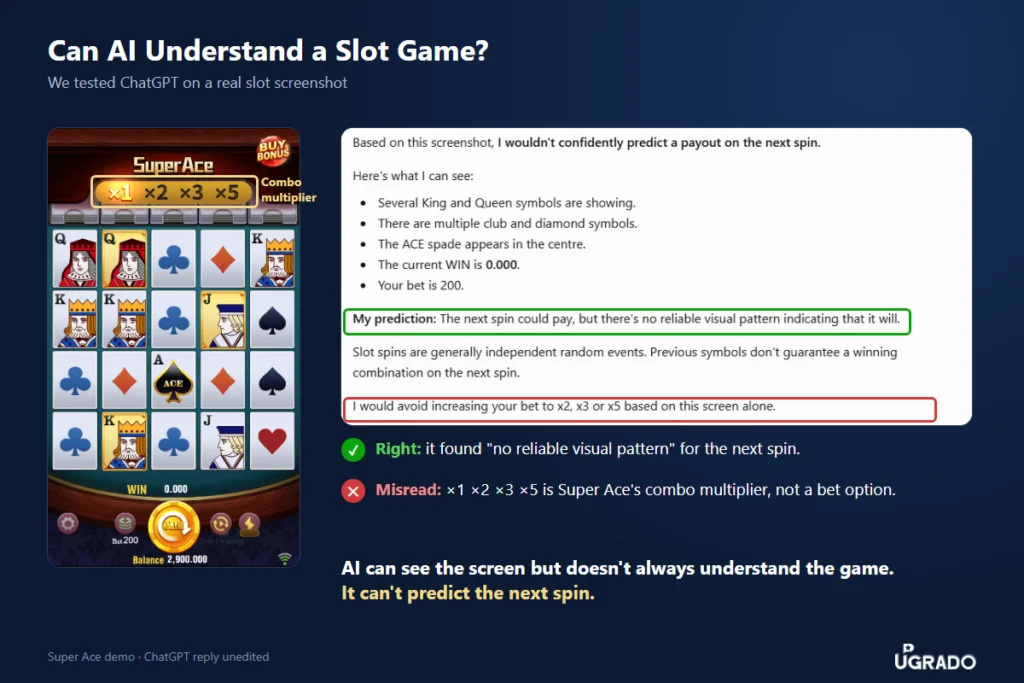
A screenshot only shows the game at one moment. It does not contain the information used to produce the next random outcome.
Why Past Spins Don’t Reveal the Next Random Outcome
Most online slots use a random number generator (RNG) to produce the values the game turns into symbols, combinations and payouts. The UK Gambling Commission’s technical standards require RNG outputs and game outcomes to be random and unpredictable. A player’s spin history shows the results the game displayed. It does not reveal the generator’s internal state, seed or algorithm.
Can Machine Learning Predict Random Number Generators?
For some generators, under specific conditions. Fox-IT researchers showed that a neural network could predict future outputs of Mersenne Twister, a pseudorandom number generator not designed for cryptographic security, once it had access to the generator’s raw outputs.
That is very different from asking ChatGPT to analyse your slot history. The researchers worked with a known generator and its raw output. A player looking at past payouts or screenshots has neither.
What about Aviator predictors?
Aviator is a crash game rather than a slot, but the question is the same: can an app know the next crash multiplier before the round ends?
Spribe says Aviator uses a provably fair system. A hashed version of the server seed is published before each round starts, and player seeds also contribute to the result. After the round, players can use this information to check that the result wasn’t changed. They cannot read the original server seed from the hash or work out the next crash point from it.
A service claiming to know the next multiplier would need information that isn’t available from game history or the published hash. Past crash points can be recorded and analysed, but they don’t predict the next round.
Do Slot Predictors Work? What Would Count as Proof?
Some predictor services advertise accuracy of 80%, 90% or even 99%. First ask what exactly the software is predicting. Any payout is different from a profitable spin or a specific winning combination. In the RM1 example, spin 3’s RM0.50 would count as a correct call if the prediction was “any payout”, and as a miss if it was “a profit”. How accuracy is defined can change the advertised figure a lot.
How a Predictor Can Claim 90% Accuracy Without Predicting Anything
Imagine a separate test of 100 spins. Ninety produce no payout and ten return some money. A predictor that guesses “no payout” every time scores 90% accuracy without identifying a single winning spin. It has only guessed the most common outcome.
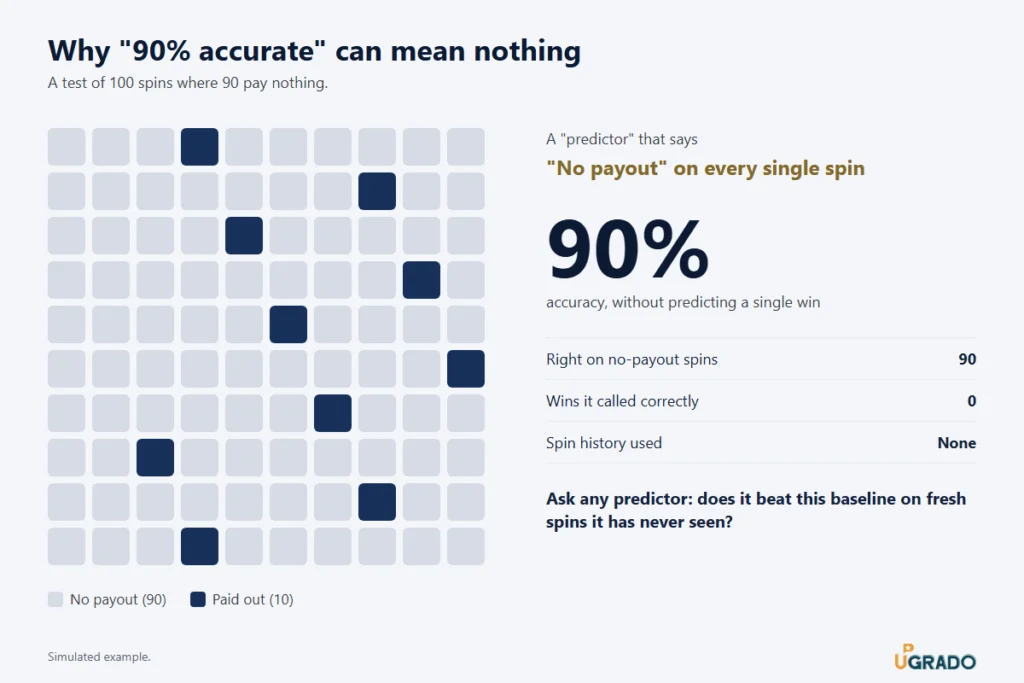
An accuracy percentage alone doesn’t show that a predictor works. A convincing test should provide:
- Predictions recorded in advance, with a timestamp showing each was made before the spin or round.
- A clear definition of success: any payout, a profitable spin, a specific combination or a crash multiplier.
- Complete results, including misses and skipped rounds.
- Fresh test data that wasn’t used to build or adjust the software.
- A suitable benchmark: the predictor should beat a simple baseline, not just quote a high percentage.
Screenshots of successful predictions can’t show any of this. They show selected wins, not the full record.
How Predictor Sellers Make Money
Some predictor services make money from referral commissions, deposits or private signal groups, and some may charge subscriptions. For these sellers, getting customers to sign up and deposit can matter more than the predictions themselves.
A 2025 investigation by the Indian outlet Decode found more than 2,000 Meta ads promoting Aviator and its “prediction services”, at least 75 YouTube channels and at least 18 Telegram groups pushing these schemes. It documented:
- Deposit schemes: one seller offered to turn Rs 5,000 into Rs 50,000 within 45 minutes, minus a 25% commission.
- Recruitment commissions of 5% to 10% for bringing in new players.
- Loss recovery offers: one player who lost Rs 35,000 on Aviator was asked to pay Rs 5,000 to recover part of it, then another Rs 15,000 after an apparent Rs 20,000 win.
These findings come from India, not the whole market, but they show how prediction claims are used to push deposits and further payments.
4 Warning Signs of a Slot or Aviator Predictor Scam
Be cautious if a predictor:
- Promises guaranteed wins, fixed crash multipliers or very high accuracy without publishing complete test results.
- Requires you to deposit through a particular casino link before you get predictions.
- Asks for your casino password, mobile banking PIN or banking OTP.
- Offers to recover money you’ve already lost in exchange for another payment.
Predictors sold as APK downloads add another risk: an unofficial app can expose your device and personal information. Our guide to slot hacks and cheat apps covers this, and our checklist for identifying legitimate and fake gambling platforms helps before you register with an unfamiliar casino.
What You Can Use AI For
AI is more useful for reviewing your play than for predicting the next result. If you keep a record of your stakes and payouts, ChatGPT can total your spending, returns and overall profit or loss. In the ten-spin example, two spins paid out but the player still finished RM6.50 down, so the net result tells you more than a count of payouts. In the ten-spin example, two spins paid out but the player still finished RM6.50 down, so the net result tells you more than a count of payouts.
AI can also explain RTP, volatility, bonus rules and game mechanics. That helps you understand a game, but it doesn’t change the odds.
If you choose to play, set a spending and time limit before you start, and avoid chasing losses. If gambling becomes hard to control, consider a time-out or self-exclusion. Our responsible gaming guide explains the options.
Frequently Asked Questions
Not by predicting results. AI can help you track your spending, compare RTPs or understand bonus terms, but it can’t tell you when a slot will pay.
Yes. AI can spot patterns in past slot results, such as a run of spins with no payout. To show that a pattern has predictive value, it would need to beat a simple benchmark on new spins.
For slots and crash games such as Aviator, none can predict the next result. If a tool claims otherwise, ask for its full test record before trusting it or depositing anything.
Not games of chance. Slots, roulette and crash games are designed so that past results don’t reveal the next one. AI can help with decisions you control, such as your budget, but not with outcomes.
No. Even if a live RTP figure accurately reflects recent results, it describes payouts over that period. It gives no reliable indication of what will happen on the next spin.

 Top Bonus Pick