
What if matching symbols didn’t need to appear along a payline to produce a slot win? That’s the idea behind Cluster Pays slots.
Unlike traditional online slots, which typically award wins through specific paylines or symbol combinations, Cluster Pays games reward groups of matching symbols that touch one another on a grid.
These groups can form different shapes and appear anywhere on the screen, as long as they meet the game’s minimum cluster requirement.
Many Cluster Pays games also feature cascading reels, special multipliers, and bonus mechanics that activate during winning sequences.
But not every grid-based slot uses Cluster Pays, and not every Cluster Pays game follows the same rules.
This guide explains how Cluster Pays works, how cascading reels affect gameplay, and the key differences between four well-known Cluster Pays titles and Sweet Bonanza’s Pay Anywhere mechanic.
What Is Cluster Pays in Slots?
Cluster Pays is a slot mechanic in which winning combinations form from groups of identical symbols touching each other horizontally or vertically.
Unlike traditional paylines, these symbols do not need to form a straight line.
For a winning cluster to count:
- The symbols must be identical or qualify under the game’s Wild rules.
- Each symbol must connect to the group through a shared edge.
- The cluster must contain the minimum number of matching symbols required by the game.
- Diagonal connections do not count in the four Cluster Pays games covered here.
The minimum cluster size varies between titles.
For example:
- Reactoonz: At least 5 connected symbols.
- Le Bandit: At least 5 connected symbols.
- Jammin’ Jars: At least 5 connected symbols.
- Aloha! Cluster Pays: At least 9 connected symbols.
A winning cluster can form an L-shape, a square, or an irregular chain. The symbols must remain connected through shared edges.
Larger qualifying clusters generally produce higher payouts according to the game’s Paytable.
Because traditional paylines aren’t used, the bet is typically expressed as a single total stake per spin, with payouts calculated from that amount.
If you’re unfamiliar with Paytables, Wilds, or other slot terms, our slot machine glossary explains them in more detail.
How Do Cascading Reels Work in Cluster Pays Slots?
Many Cluster Pays slots combine connected-symbol wins with Cascading Reels, also called Tumbles or Avalanches.
The process usually works as follows:
- A qualifying group of matching symbols forms a winning cluster.
- The winning symbols are removed from the grid.
- Remaining symbols move to fill the empty spaces.
- New symbols appear in the available positions.
- If another winning cluster forms, the process continues according to the game’s rules.
These additional sequences occur as part of the same paid spin, without a separate wager for each cascade.
However, not all Cluster Pays games use the same cascading mechanic. Aloha! Cluster Pays, for example, features Sticky Win Re-spins that operate differently from traditional symbol-removal cascades.
What Makes Cascading Cluster Slots Different?
Game developers often combine cascades with additional features, including:
In Reactoonz, symbols removed from winning clusters contribute to the Quantum Leap meter.
As the meter fills, special Quantum features can activate, including Gargantoon, a large 3×3 Wild symbol.
Jammin’ Jars uses special jar symbols that act as Wilds and carry multipliers.
The multipliers begin at 1× and can increase during qualifying cascading sequences.
As explained in Push Gaming’s multiplier guide, jars involved in winning combinations can move and increase their multiplier values. When multiple jars contribute to the same win, their multipliers can be combined according to the rules.
In Le Bandit, winning clusters can leave marked positions on the grid.
When the Rainbow feature activates, these marked positions can become Golden Squares, revealing additional symbols, including coins and multipliers.
Important: Cascades do not mean the game is building toward a guaranteed win. The Random Number Generator (RNG) determines outcomes according to the game’s programmed rules, and previous cascades cannot reliably predict the next result.
Four Popular Cluster Pays Slots Compared
The following four games use Cluster Pays mechanics, but they differ in grid size, minimum winning clusters, RTP, volatility and special features.
| Game | Provider | Grid | Minimum cluster | Reported RTP |
|---|---|---|---|---|
| Aloha! Cluster Pays | NetEnt | 6×5 | 9 symbols | 96.42% |
| Reactoonz | Play’n GO | 7×7 | 5 symbols | 96.51% |
| Jammin’ Jars | Push Gaming | 8×8 | 5 symbols | 96.83% |
| Le Bandit | Hacksaw Gaming | 6×5 | 5 symbols | 96.34% |
These are the default or commonly published RTP values in the original article. Alternative RTP versions may exist, and some values come from third-party reviews. Check the applicable version in the game’s information screen.
1. Aloha! Cluster Pays (NetEnt, 2016)
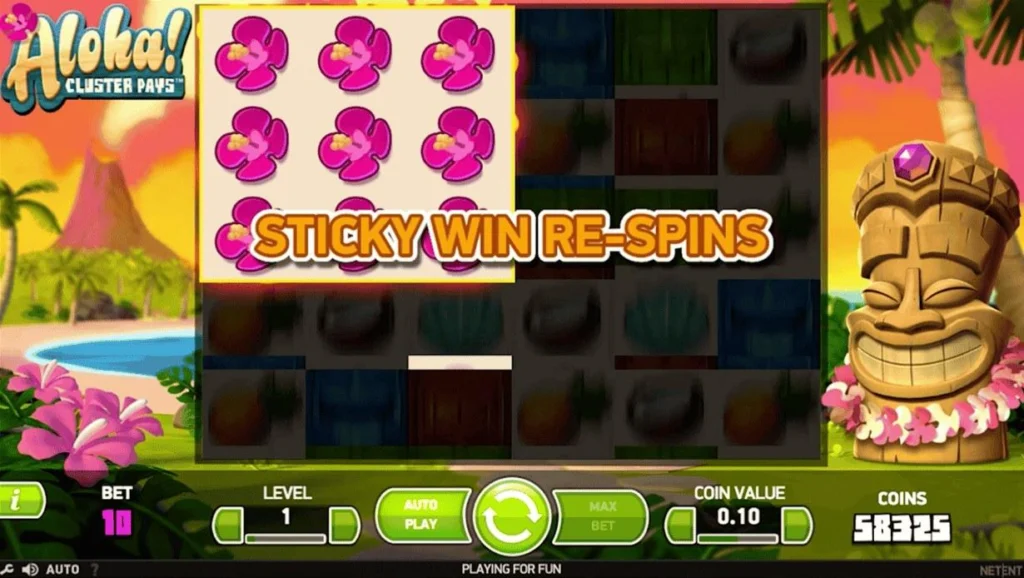
Released on 22 March 2016, Aloha! NetEnt described Cluster Pays as its first game to use the Cluster Pays mechanic.
Unlike games that require five connected symbols, Aloha! needs at least nine matching symbols touching horizontally or vertically to form a winning cluster.
The game also introduces Sticky Win Re-spins, where a winning cluster remains locked while the remaining grid positions respin.
This makes it a useful example of how Cluster Pays can work without relying entirely on conventional cascading reels.
Key Features
- Released: 22 March 2016
- Layout: 6 reels × 5 rows
- Minimum cluster: 9 connected matching symbols
- Published RTP: 96.42%
- Reported hit frequency: 21.00%
- Maximum payout: 700× the total bet
- Special features: Substitution Symbols, Sticky Win Re-spins and Free Spins
How Do Aloha!’s Bonus Features Work?
Substitution Symbols can transform into qualifying adjacent symbols to create the highest-paying available cluster under the game’s rules.
Sticky Win Re-spins hold the winning symbols while the other positions respin, allowing the qualifying group to potentially expand.
The game also offers 9 to 12 Free Spins when 3 to 6 Free Spin symbols appear, respectively. During this feature, Symbol Drop can remove lower-paying symbols from the grid.
Aloha!’s distinctive mechanic combines a nine-symbol minimum with Sticky Win Re-spins.
Its maximum advertised payout of 700× is lower than the other three games discussed, though that alone doesn’t show how often it pays.
2. Reactoonz (Play’n GO, 2017)

Reactoonz is one of the most recognisable grid-based Cluster Pays games.
Released on 23 October 2017, this Play’n GO title uses a 7×7 grid and awards qualifying cluster wins from five or more connected matching symbols.
Unlike traditional paylines, these winning groups can form anywhere on the grid.
The game is also known for its Quantum Leap system, which accumulates progress through qualifying winning symbols.
Key Features
- Released: 23 October 2017
- Layout: 7×7 grid
- Minimum cluster: 5 connected matching symbols
- Commonly reported RTP: 96.51%
- Alternative RTP versions: 94.51% and 91.49%, according to review-site data
- Maximum advertised win: 4,570× the total bet
- Volatility: 10/10 on Play’n GO’s scale
- Special features: Flux Capacitor Wilds, Quantum Leap, Quantum features and Gargantoon
What Makes Reactoonz Different?
Reactoonz connects its cascading wins to the Quantum Leap meter.
Winning symbols contribute to the meter, which can activate four different Quantum features.
One of the most distinctive is Gargantoon, a 3×3 Wild that can split into two 2×2 Wilds and eventually nine individual Wilds across successive cascades.
This creates a more complex bonus structure than games that only remove and replace winning symbols.
However, Reactoonz also carries a very high volatility rating. Its features and large advertised maximum win do not guarantee frequent or substantial payouts.
3. Jammin’ Jars (Push Gaming, 2018)

Jammin’ Jars was announced by Push Gaming on 18 September 2018.
The game uses an 8×8 grid, with qualifying wins beginning at five or more connected matching fruit symbols.
Its main feature is special Jam Jar symbols that act as both Wilds and Scatters.
Each jar starts with a 1× multiplier, which can increase during qualifying cascading sequences.
Key Features
- Released: 18 September 2018, based on Push Gaming’s launch announcement
- Layout: 8×8 grid
- Minimum cluster: 5 connected matching symbols
- Commonly published RTP: 96.83%
- Alternative RTP: 94.25%
- Highest observed win reported in the source: 19,998.5×
- Volatility: High
- Special features: Multiplier Wilds, Free Games, Rainbow and Bonus Buy where permitted
How Do Jammin’ Jars Multipliers Work?
During cascading sequences, qualifying Jam Jar symbols can move across the grid.
If a jar contributes to a winning combination, its multiplier may increase according to the game’s rules.
When several jars contribute to the same winning group, their multipliers can be combined.
Three or more Jam Jar symbols appearing anywhere on the grid can trigger Free Games.
The game also features a randomly activated Rainbow effect, which introduces giant fruit symbols.
A Bonus Buy option may be available in jurisdictions where the feature is permitted.
Jammin’ Jars shows how Cluster Pays can combine moving Wilds with multiplier progression.
However, a higher multiplier does not guarantee another winning cluster, and the reported highest observed win should not be confused with a guaranteed or universally available maximum payout.
4. Le Bandit (Hacksaw Gaming, 2023)

Released in August 2023, Le Bandit combines Cluster Pays with special coin symbols, Golden Squares and Super Cascades.
The game uses a 6×5 grid, with winning clusters beginning at five or more connected matching symbols.
Unlike a basic Cluster Pays slot, Le Bandit also uses marked positions that can interact with Rainbow symbols to activate additional features.
Key Features
- Released: August 2023
- Layout: 6 reels × 5 rows
- Minimum cluster: 5 connected matching symbols
- Default RTP: 96.34%
- Alternative RTP versions: 94.23%, 92.17% and 88.36%
- Maximum advertised win: 10,000× the total bet
- Volatility: 3/5 on Hacksaw Gaming’s scale
- Special features: Super Cascades, Golden Squares, Coins, Four-Leaf Clovers and Pots of Gold
How Do Le Bandit’s Special Features Work?
Le Bandit includes several interacting bonus symbols:
- Golden Squares: Marked positions can turn golden when activated by a Rainbow.
- Bronze, Silver and Gold Coins: Special coins display different values, with Gold Coins reaching up to 500×.
- Four-Leaf Clovers: Can apply multipliers ranging from 2× to 10× to adjacent positions.
- Pots of Gold: Collect qualifying coin values according to the game’s rules.
- Free Spins: Three bonus modes are available, triggered by 3, 4 or 5 Scatter symbols.
Le Bandit’s Cluster Pays mechanic works alongside its coin-collection and bonus-symbol system.
Its volatility rating of 3/5 should be interpreted using Hacksaw Gaming’s own scale, rather than compared directly with another provider’s rating.
The presence of a 10,000× advertised maximum win does not indicate how frequently that outcome occurs.
Is Sweet Bonanza a Cluster Pays Slot?
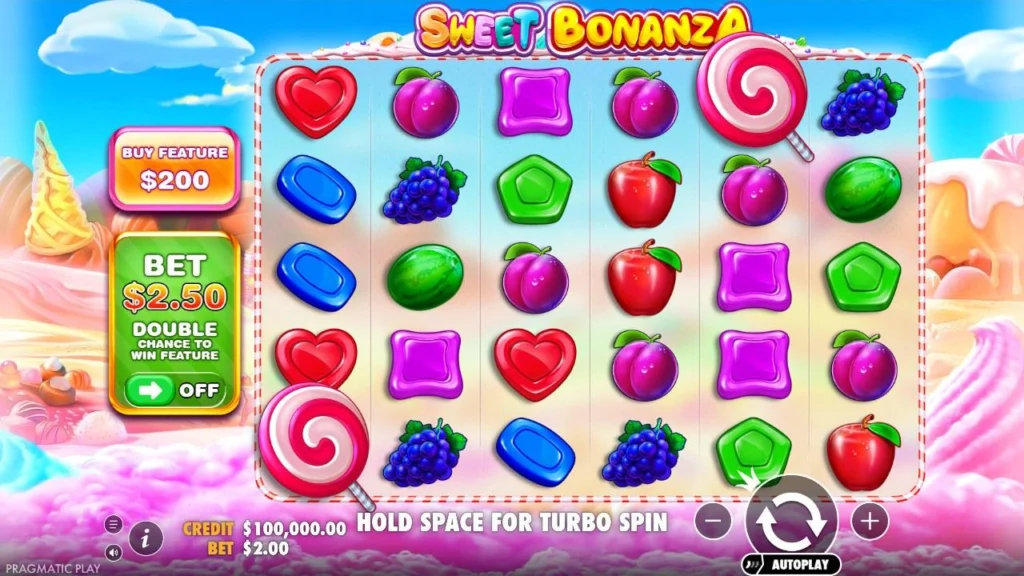
No. Sweet Bonanza uses a Pay Anywhere mechanic, not Cluster Pays.
Although Sweet Bonanza shares some visual similarities with Cluster Pays games, the winning rules are different.
According to its official Pragmatic Play game page, winning combinations require eight or more matching symbols appearing anywhere on the grid.
The symbols do not need to touch.
By comparison, a true Cluster Pays game requires the matching symbols to connect horizontally or vertically.
Sweet Bonanza Key Features
- Released: June 2019
- Layout: 6 reels × 5 rows
- Winning requirement: 8 or more matching symbols anywhere on the screen
- Published RTP: 96.48%
- Special features: Tumbles, Free Spins and multiplier symbols
Four or more Scatter symbols can award 10 Free Spins, with Scatter payouts up to 100×, according to the game’s rules.
During Free Spins, multiplier symbols ranging from 2× to 100× may appear. The game combines applicable multipliers at the end of the tumbling sequence.
Cluster Pays vs Pay Anywhere: What’s the Difference?
| Feature | Cluster Pays | Pay Anywhere |
|---|---|---|
| Winning requirement | Matching symbols must connect | Matching symbols can appear anywhere |
| Minimum symbol count | Depends on the game | Depends on the game |
| Diagonal-only connections | Do not count in the examples covered | Connection is not required |
| Traditional paylines | Not used | Not used |
| Cascading features | Common, but not universal | Available in many titles |
For example, eight matching symbols scattered across different positions may qualify for a Pay Anywhere win in Sweet Bonanza.
Those same symbols would not form a winning Cluster Pays combination unless enough were connected to meet the cluster requirement.
Both types of games can feature cascading reels, which explains why they are sometimes grouped together.
Cluster Pays vs Payline Slots: Advantages and Limitations
Cluster Pays and traditional Payline slots use different ways to determine winning combinations.
Neither mechanic is automatically more profitable or more likely to produce wins.
Advantages of Cluster Pays Slots
- Flexible winning shapes: Qualifying clusters can form across the grid without following fixed paylines.
- Cascading sequences: Many titles allow additional winning combinations to form during the same paid spin without another wager.
- Additional features: Grid-based mechanics support meters, moving Wilds, multipliers and marked positions.
Advantages of Traditional Payline Slots
- Simpler visual structure: Winning combinations are often easier to follow along defined lines.
- Familiar rules: Players can identify the relevant paylines and winning symbol patterns through the Paytable.
- Different volatility options: Some traditional Payline games offer lower volatility, although this depends on the individual title.
Are Cluster Pays Slots More Volatile?
Not necessarily.
Volatility depends on a game’s mathematical design, including symbol probabilities, bonus frequency, multipliers and payout distribution.
For example, Aloha! Cluster Pays has an advertised maximum payout of 700×, while Reactoonz carries a volatility rating of 10/10.
However, neither a lower maximum payout nor the Cluster Pays mechanic alone is enough to determine a game’s volatility.
To understand these differences, read our guide to RTP and volatility.
Also remember that casinos may offer different RTP configurations of the same game, so check the figure displayed in the actual game.
Which Cluster Pays Slot Has the Features You’re Looking For?
Rather than choosing a game based solely on its advertised maximum win, it is more useful to compare the mechanics and information available.
Aloha! Cluster Pays demonstrates a nine-symbol minimum and Sticky Win Re-spins, making it different from typical five-symbol cascading games.
Reactoonz focuses on its Quantum Leap meter, evolving Wild features and a large 7×7 grid.
Jammin’ Jars combines an 8×8 grid with moving Jam Jar Wilds and increasing multipliers.
Le Bandit adds Super Cascades, Golden Squares, Coins and Pots of Gold to its Cluster Pays system.
Each game uses an RNG to determine its outcomes. Features such as cascades, meters and multipliers change how potential wins are calculated, but they cannot reliably predict future results.
If you choose to play, set a budget you can afford to lose and treat the game as entertainment.
An official demo, where available, can also help explain the mechanics without requiring a real-money wager.
Conclusion: Understanding Cluster Pays Slots
Cluster Pays slots replace traditional paylines with a different winning rule: a minimum number of identical symbols must connect on the grid.
Many games expand this mechanic through cascading reels, charge meters, multiplier Wilds and special bonus features.
However, the specific requirements vary between titles.
Before evaluating a Cluster Pays game, check its minimum winning cluster, Paytable, RTP version and volatility rating.
These details explain how the game operates but do not guarantee wins or predict future outcomes.
And remember: if matching symbols can win without touching, the game may use Pay Anywhere rather than true Cluster Pays.
Frequently Asked Questions (FAQs)
Cluster Pays slots award wins when a minimum number of matching symbols form a connected group on the grid. The symbols generally need to touch horizontally or vertically rather than follow traditional paylines.
The minimum cluster size and payout depend on the specific game’s rules.
It depends on the game. Reactoonz, Jammin’ Jars and Le Bandit require at least five connected matching symbols. Aloha! Cluster Pays requires nine.
Always check the game’s Paytable for its exact winning requirements.
No. Sweet Bonanza uses Pay Anywhere. It awards qualifying wins when eight or more matching symbols appear anywhere on the grid, even if they are not touching. Cluster Pays requires symbols to form a connected group.
Not automatically. Volatility depends on each game’s mathematical design, including payout distribution, bonus features, and multipliers. Cluster Pays can be found in games with different volatility levels.
Normally, no. Cascading sequences take place within the same paid spin. Winning symbols are removed and replaced, and additional qualifying clusters can be awarded without another wager. However, game-specific bonus features may follow different rules.
Yes. Some providers release several RTP configurations of the same game. For example, the original article lists four RTP settings for Le Bandit and two for Jammin’ Jars.
Players should check the RTP displayed in the game’s information screen, as it may differ from the commonly advertised version.

 Top Bonus Pick