

The 5 spin rule is an informal method: play up to five spins on a slot, then switch games if nothing pays. Some versions suggest leaving after the first payout.
It does not reliably identify a slot that is about to pay. Five losing spins do not show that the sixth is less likely to pay, or that another game offers better odds.
The rule can limit your bets on one game. However, switching alone does not reduce expected losses when total wagering and RTP remain the same.
How the 5 Spin Rule Works
There is no official version, but two common descriptions are:
- Five-spin test: Switch games if five spins produce no payout.
- Stop-on-win: Leave after the first payout, however small.
Virgin Games’ blog says the 5 spin slot method was coined by a YouTuber known as Professor Slots. It rests on the belief that a slot that doesn’t pay within five spins is “cold”.
Using five spins as a stopping point is different from claiming they predict what happens next.
Why Five Spins Cannot Identify a Winning Slot
In a conventional slot that uses a random number generator (RNG), previous wins and losses do not change the next spin’s probabilities when the configuration and relevant game state remain unchanged. That’s why the idea of hot and cold slots is a myth.
Five spins without a payout are also quite plausible by chance.
Hypothetical calculation assuming independent spins and a constant payout probability. These are not figures for a specific game.
| Payout probability per spin | Chance of 5 spins with no payout |
|---|---|
| 20% | 32.8% |
| 25% | 23.7% |
| One in three, approximately 33.3% | 13.2% |
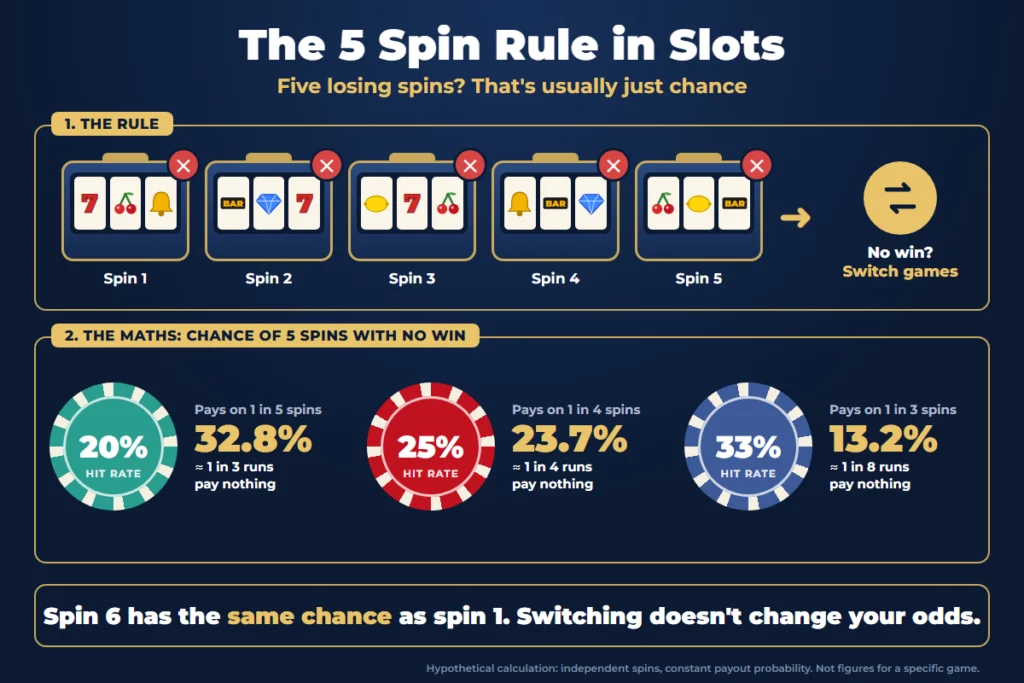
For a game with a 25% payout probability, five consecutive spins would return nothing about 23.7% of the time. The next spin would still have a 25% payout probability under these assumptions.
A payout is not necessarily a profit, either. Receiving RM0.50 from a RM1 spin still means losing RM0.50. Treating any payout as a successful test overlooks that distinction.
These payout probabilities are not RTP figures. Our slot machine terms guide explains the difference between RTP and other game characteristics.
Some games retain collection progress or bonus states between spins. Any effect comes from their published feature rules, not from reaching spin five.
Does Switching Slots Reduce Your Losses?
Switching based on recent results does not itself create an advantage. Different online slots in Malaysia can have different mathematical settings, but five spins do not establish which game offers better conditions.
Assume every game has a 96% RTP and each spin costs RM1. The theoretical expected loss is RM0.04 per spin.
| Playing pattern | Total wagered | Expected loss |
|---|---|---|
| 100 spins on one game | RM100 | RM4 |
| 5 spins on each of 20 games | RM100 | RM4 |
Theoretical example assuming the same 96% RTP throughout. Actual results can be substantially higher or lower.
Switching can increase expected losses if the replacement has a lower RTP. Check the configuration offered rather than judging it from recent payouts. Our guide to slot RTP versions explains what to look for.

RTP figures from in-game rules or public listings.
Can the 5 Spin Rule Help You Control Spending?
Only if it leads you to place fewer bets overall.
Five spins at RM1 followed by stopping means RM5 wagered. Five spins on each of ten games means RM50 wagered. Switching resets the count, but it does not reset your spending.
Set a loss limit and time limit covering the whole session. For example, stop at a maximum net loss of RM50 or after 30 minutes, whichever comes first, without adding further funds. Our responsible gaming tips explain setting limits and avoiding chasing losses.
Frequently Asked Questions
You can stop whenever you choose. Five losing spins do not prove the slot will keep losing, and there is no obligation to continue to recover your money.
A losing streak alone does not make a random slot due to pay. A collection feature may have specific progress rules, but that is different from compensating for earlier losses.
More spins provide more past results, but they do not make independent outcomes predictable. There is no special spin count that reveals when the next payout will occur.

 Top Bonus Pick